
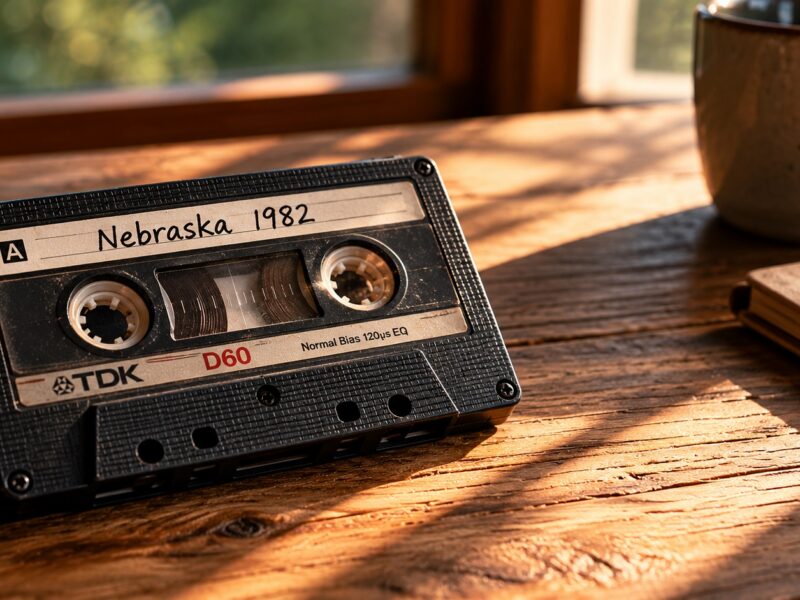
The other night, I watched Deliver Me From Nowhere, Bruce Springsteen’s biopic based on Warren Zanes’ book about the creation of the Nebraska album in 1982 in Colts Neck, New Jersey.
Springsteen had fame and had just come off a successful tour promoting The River (1980).
He wanted to do something different with his next album. At the same time, he was wrestling with memories of his father and trying to make sense of a relationship that never fit neatly into hero or villain.
Did I like it? Rob asked me.
Yes.
It was restrained. Slow simmering. Observant. It revealed his fraught relationship with his father through quiet observations — the micro traumas.
Not explosive moments. Smaller ones.
The film softens things without erasing them, so you can keep moving forward.
It’s human. Messy. Raw.
An acknowledgment of what people can and cannot give each other.
Maybe that’s why it felt familiar.
What stayed with me afterward wasn’t a single scene. It was the accumulation of small moments.
Around the same time, I was listening to an episode of The Afternoon Shift about burnout and the cumulative effect of stress. One idea stuck with me from guest Amy Campbell: nothing has to be huge. The little “t’s” add up.
Eventually, you reach a point where pushing through no longer works.
Springsteen reaches that point in the film. He turns to his manager. Later, a therapist asks him a question about his childhood, and the emotions he’s been carrying finally break through.
At the end of the film, Springsteen’s father tells him:
“I’m proud of you. I know I wasn’t always good to you.”
And Bruce responds:
“You did the best you could.”
I had tears in my eyes.
So poignant.
Recognition.
Regret.
Late reconciliation that doesn’t erase the past.
Springsteen knew he had something with Nebraska. He wanted to preserve the raw feeling of the songs — gritty, imperfect, human.
I’m glad he trusted the recording.
Sometimes the raw edges are the point.

 Motherhood and Storytelling

Watching the film I also felt it was a slow simmer. The pain came through , the feeling of being lost and the odd juxtaposition ( SAT word) of deep depression after huge success and glorification. I thought Jeremy Allen White did a good job.
100% agree!