Women belong in all places where decisions are being made. —Ruth Bader Ginsburg
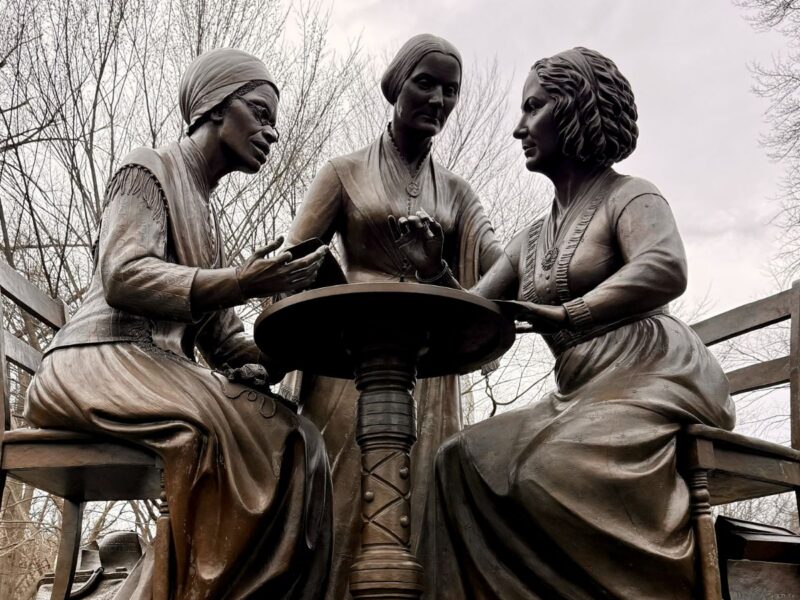
I recently took a photo of a bronze statue in Central Park.
Three women—Sojourner Truth, Susan B. Anthony, Elizabeth Cady Stanton—seated at a table, mid-conversation. Not posed. Not ornamental. Working.
And all around them, statues of men.
Women’s Rights Pioneers, created by sculptor Meredith Bergmann, was the first monument in the park to depict real women. And it was long overdue. Installed in 2020, it finally broke the bronze ceiling.
The project was led and championed by the nonprofit Monumental Women, whose mission is to address the absence of real women represented in Central Park statues.
Before this monument, Central Park had zero statues of real historical women, only fictional female figures like Alice in Wonderland and Mother Goose (created by men).
Zooming out, the imbalance is even more striking: there are only about ten monuments to women’s suffrage across the entire United States. Just one visible chapter in a much broader, multifaceted history of women’s contributions.
This statue wasn’t just added to the park. It changed the narrative of who is remembered in public space.
What We Choose to Preserve
The absence of women in bronze isn’t just about statues.
It reflects something deeper: who gets remembered, who gets archived, who gets called “great.”
In 1971, art historian Linda Nochlin asked a question that still unsettles:
Why have there been no great women artists?
Not because there weren’t women creating.
But because the conditions required for recognition—training, time, access, visibility—were systematically withheld.
For centuries, women were:
- excluded from formal training
- barred from academies
- overlooked in museums and textbooks
Browsing a gift shop, I spotted a book in the children’s section: We Are Artists: Women Who Made Their Mark on the World by Kari Herbert.
A beautifully illustrated book profiling fifteen women artists, including Frida Kahlo, Yayoi Kusama, Georgia O’Keeffe, and Alma Thomas, published to correct art history’s imbalance.
Things are changing—but slowly, and often in places we least expect.
In galleries and outside of them, artists have long been pushing back.
Guerrilla Girls used posters and anonymity to expose how few women were represented in museums. Others published books, distributed underground magazines, and created independent archives to showcase work that exists even when it isn’t formally recognized.
What Gets Lost
Looking at the monument, I kept thinking about something else:
Not just who is missing in bronze, but who never made it into the record at all.
So much of women’s creative work has been:
- uncredited
- misattributed
- unpublished
- unarchived
Not lost because it lacked value, but because no one deemed it necessary to keep.
And still, women created. In letters, in journals, in studios, in kitchens, in margins not meant to last.
Work that was lived before it was ever recognized.
Women Carry Stories
Women carry stories of sacrifice, history, patience, courage, nurturing, resilience, love, hope, strength—often unseen.
That line feels connected to this monument.
Because what we are seeing now, whether in bronze, in books, or in rediscovered archives, is not new creation.
It’s recognition catching up to reality.
Because the shift isn’t just about monuments.
It’s about attention.
What Creativity Requires
We often talk about creativity as inspiration. But it requires something more concrete:
- time
- space
- permission
- a record
It requires a world that says: this work matters enough to be seen and kept, not dismissed or made invisible in the first place.
And historically, women were denied those conditions.
Not always explicitly.
But consistently.
And still, they created change.
The movement for women’s suffrage required its own kind of creativity: patience, strategy, and the courage to imagine a different reality.
Susan B. Anthony cast her vote in 1872, was arrested, tried, and fined for breaking the law.
More than defiance–action.
The act of seeing a world that did not yet exist.
I live in Rochester, New York—her home.
Her presence is everywhere.
And still, it’s easy to take for granted what is right in front of me.
Breaking the Bronze Ceiling
That phrase keeps echoing.
Because it applies beyond statues.
It shows up in:
- whose work is published
- whose voices are cited
- whose ideas are funded
- whose names are remembered
And maybe most quietly, who feels allowed to call themselves an artist, a writer, an innovator.
These women in Central Park are no longer missing.
They are seated at the table.
In conversation. In motion. In history.
And maybe that’s what’s changing now: Not that women are finally creating, but that we are finally learning to see, preserve, and value what has always been there.
Life cannot be imagined without women’s contributions.
Not as an addition.
As essential.
And still—there is more work to be done.

 The Shift

Kris I LOVE this article. The line
“ it finally broke the bronze ceiling.”
is fantastic. Now more than ever the right of women’s suffrage should not be taken for granted and should be protected.
You’re awesome